From Bystander to Defender: What to Record, Say, and Know When Justice Is on the Line Jul 25, 2025
CEO’s Corner: Justice by Design- What a Tech-Based Movement Looks Like
 Dear Partners in Progress,
We are witnessing a revolution— and it’s not being televised. It’s being coded. It’s being recorded. It’s being organized by everyday people refusing to be silenced by systems that have historically treated them as disposable.
At Lustitia Aequalis, we’re not just imagining a fairer world, we’re building the tools to demand it. We believe justice must be accessible, actionable, and accountable. That’s why we’re at the forefront of a civic tech movement reshaping what equality and empowerment looks like in real time for your civil and human rights with law enforcement and medical centers across the globe.
Our focus is bold and unflinching: protecting your rights at the intersection of law enforcement and healthcare.
💡 When Injustice Shows Up in a Lab Coat or a Badge
We refuse to accept that being sick or scared should make you a suspect. Too often, the systems designed to care, protect, and serve become the ones that criminalize us—especially if you’re Black, Brown, undocumented, poor, homeless, 0or struggling with mental health. Whether it’s a police stop gone wrong or a hospital visit that ends in handcuffs, we are fighting back with tools, knowledge, and truth.
From our Witness app that helps people safely record encounters, to our rights literacy campaigns teaching communities what to say, what to record, and what their rights actually are, we’re changing the game. And in healthcare? We’re holding institutions accountable for neglect, coercion, and bias, especially when it comes to marginalized patients and informed consent.
🛠️ This Is What Justice Tech Looks Like
Justice doesn’t just live in courtrooms. It lives in code, in policy, in everyday choices. Our approach is community-centered, data-informed, and driven by individuals who believe in fundamental care, genuine accountability, and rights that are not compromised behind closed doors.
You don’t need a law degree to stand up for yourself. You need information. You need tools. You need a movement that’s with you, not just watching.
That’s who we are.
🔥 The Future Is Now—And We Need You In It
We’re calling on advocates, donors, healthcare workers, legal professionals, and everyday change-makers to join us. This is bigger than one app or one story. This is about rewriting the rules for how we treat each other and making sure justice finally shows up where it’s needed most.
Let’s build a system where no one’s health or humanity can be weaponized against them.
Because justice by design isn’t just our mission. It’s our blueprint.
In Solidarity,

Ashley T. Martin
CEO, Lustitia Aequalis
Table of Contents:
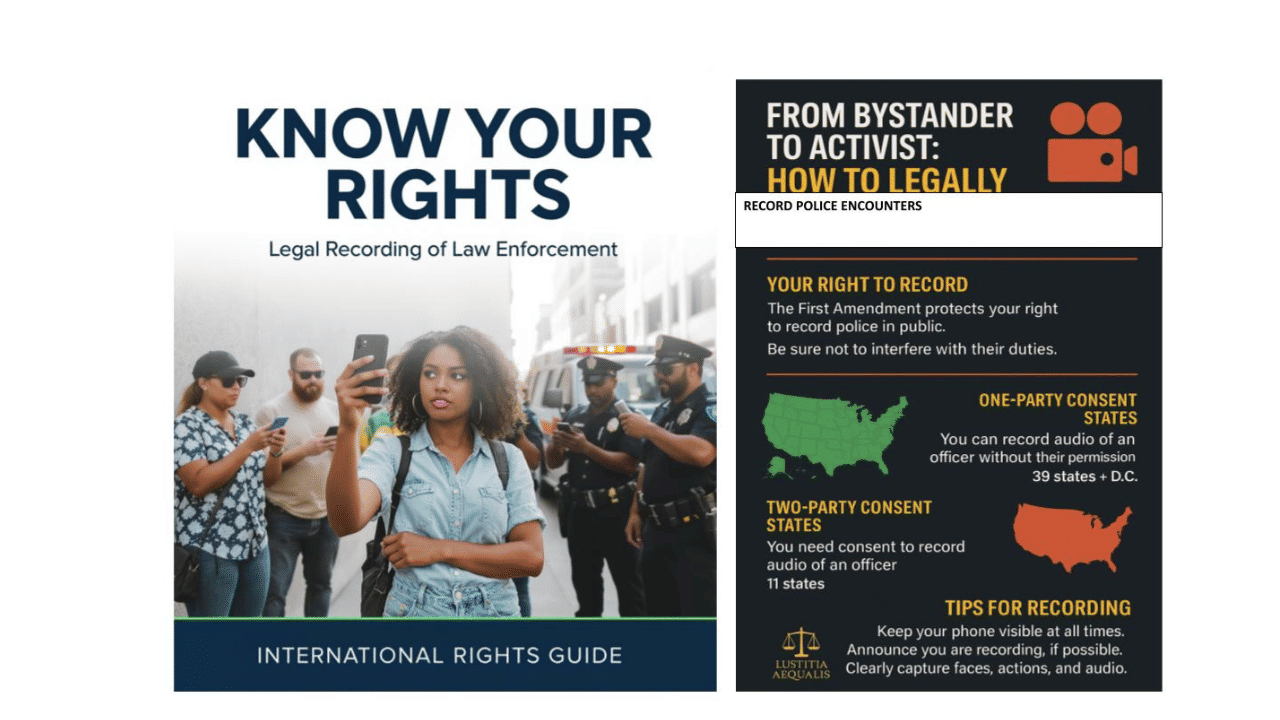
From Bystander to Activist: How to Legally Record Police Encounters
What to Say If You’re Stopped and You’re Undocumented: Real Talk, Real Rights
Can a Hospital Call the Police on You? Know When You’re a Patient, Not a Suspect
The Price of Noncompliance: What Happens When You Say No to a Search?
Mental Health Crises Shouldn’t Lead to Jail Time: What Are Your Rights in a 911 Call?
What Is Informed Consent—And How Often Is It Ignored in Black Healthcare?
By Lustitia Aequalis
Because Justice Needs Evidence— and So Do You
We live in an era where one video can shift public opinion, spark protests, or even lead to criminal charges. Think of the 2020 murder of George Floyd, captured not by the police, but by 17-year-old Darnella Frazier. Her video became the key evidence that sparked a global movement for justice.¹
In the age of smartphones, a single video can hold police accountable, elevate unheard voices, and ignite national and international change. When 17-year-old Darnella Frazier filmed George Floyd’s murder in 2020, she didn’t just capture a crime, she preserved the truth.
Recording police is no longer just an act of awareness, it’s a form of protection, advocacy, and resistance. Recording means the world can see what actions were law abiding, and what actions are not- from all parties.
Today, the right to record is more than an act of awareness. It’s a form of resistance, self-defense, and civic action. But do you know how to do it legally?
⚖️ U.S. Law: You Can Record the Police, But Know Your State Laws
Under the First Amendment, you have the right to record public officials, including police officers, in public spaces. Courts have affirmed this right repeatedly, including:
Glik v. Cunniffe (2011) – The First Circuit ruled that filming public officials is a clearly established constitutional right.
Fields v. City of Philadelphia (2017) – The Third Circuit upheld the right to record even when not challenging officers in the moment.
However, recording audio, especially during encounters, can trigger state-level wiretap or eavesdropping laws, which fall into two major categories: one-party consent and two-party (or all-party) consent.
However, state-level wiretapping laws can complicate the issue when it comes to recording audio during police stops.
🟢 ONE-PARTY CONSENT STATES (38 STATES + D.C.)
In these states, you can record a conversation if you are a participant. You do not need to inform or get consent from the other party.
You are generally safe to record police interactions openly, especially in public spaces.
✅ One-Party Consent Jurisdictions:
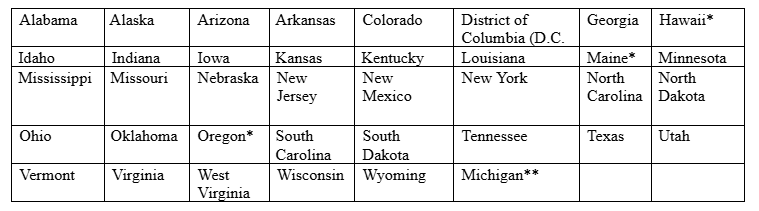
Hawaii, Maine, and Oregon generally require one-party consent but may treat certain scenarios or devices differently.
*Michigan law is ambiguous and debated; state courts have leaned toward one-party interpretation, but with limitations.
🔴 TWO-PARTY CONSENT STATES (12 STATES)
In these states, all parties must consent to the recording of any audio communication. Even if you're in a public space, secretly recording could result in criminal charges under wiretapping statutes.
⚠️ Two-Party Consent States:

*Delaware generally requires all-party consent for in-person conversations, but phone call laws are more permissive in some cases.
📝 Want to know your state’s law?
The Digital Media Law Project (DMLP) and Reporters Committee for Freedom of the Press (RCFP) both maintain regularly updated state-by-state guides.⁶
🌐 What About Recording Across State Lines?
This is where things get complicated.
If you're calling, livestreaming, or interacting with someone across state lines, and one state is a two-party consent state, the stricter law may apply.
Example: If you're in New York (one-party) but the officer is in Pennsylvania (two-party), you may be violating PA law by recording without their consent.
⚖️ Best Practice: Always assume the most restrictive rule applies. When in doubt, ask or announce that you’re recording.
🌍 A Global Trend Toward Accountability
Many democracies around the world are embracing public recording of law enforcement:
United Kingdom – Legal to record police; many officers wear body cameras.
Germany – Legal to film but sharing footage can raise privacy concerns.
South Africa – Recording is legal if you do not obstruct the police.
Brazil – Human rights advocates encourage filming to combat abuse.
While laws vary, the principle is clear: public oversight strengthens democracy.
🌍 Global Snapshot: Recording Police in Other Democracies
Around the world, laws vary—but public accountability is becoming the norm.
United Kingdom: It’s legal to film police in public, and police often wear body cameras themselves.⁸
Germany: Filming is legal, but sharing without consent may violate privacy laws.⁹
South Africa: Citizens can film police as long as they don’t obstruct official duties.¹⁰
Brazil: Civil rights groups actively encourage filming as a tool to combat police brutality.¹¹
Despite the differences, a common thread unites democratic nations: the right to document is increasingly seen as essential to democracy and public oversight.
📲 Tech That Protects: The Witness App by Lustitia Aequalis
Recording is powerful. But in the heat of a crisis, pulling out your phone isn’t enough. You need speed, backup, and security. That’s why Lustitia Aequalis created the Witness app.
With one tap, the Witness app:
Begins recording video and audio
Sends a real-time alert and location to a designated emergency contact
Uploads footage securely to the cloud for your counsel review so it can’t be deleted or lost
Whether you’re stopped by law enforcement, experiencing/ witnessing abuse, receiving medical dismissiveness, or trying to protect someone else, Witness puts your rights in your hands.
🚨 Call to Action: Turn Your Camera Into a Shield
Don’t wait until you’re scared. Don’t wait until someone’s screaming. Learn to record before it’s urgent.
✅ Download the Witness app today
✅ Share this article with the hashtag #FromWitnessToWarrior
✅ Practice activating your phone and stating: “I am recording for my safety and yours.”
Your phone is more than a screen, it’s a tool of resistance.
When someone says, “They won’t believe me”, you can be the reason they’re wrong.
📚 SOURCES:
The New York Times (2021) – “Darnella Frazier Captured George Floyd’s Death on Her Cellphone.”
ACLU – “You Have a Right to Film Police.” https://www.aclu.org/know-your-rights/protesters-rights/#filming
Glik v. Cunniffe, 655 F.3d 78 (1st Cir. 2011)
Reporters Committee for Freedom of the Press – “Can We Tape?” https://www.rcfp.org/reporters-recording-guide/
Digital Media Law Project – “State Law: Recording.” https://www.dmlp.org/legal-guide/recording-phone-calls-conversations-and-disclosures
RCFP – State-by-State Recording Laws.
Harvard Berkman Klein Center – Recording Laws Overview.
UK Home Office – “Body Worn Video Guidance for Police” (2020)
German Federal Data Protection Act (BDSG)
Legal Resources Centre South Africa – “Your Rights When Interacting with Police”
Human Rights Watch – Brazil Reports on Police Violence & Video Evidence
By Lustitia Aequalis
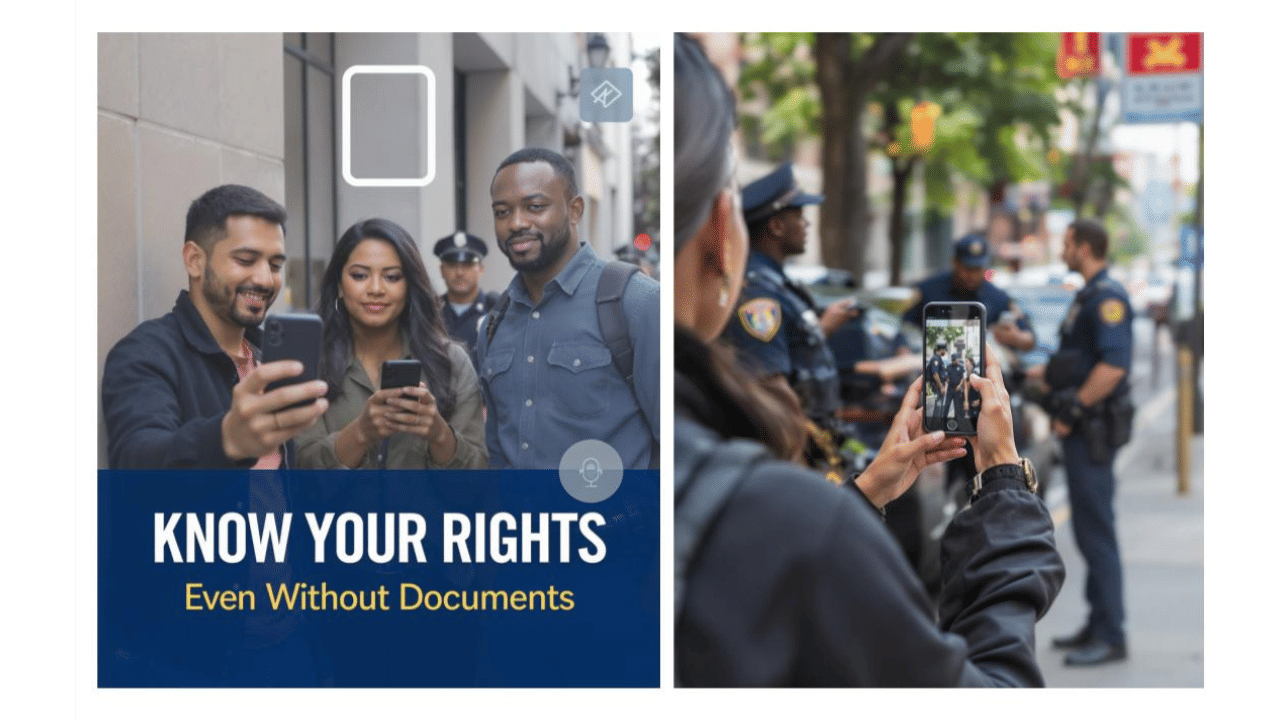
Engaging with law enforcement or immigration officials can be overwhelming for undocumented individuals, often accompanied by anxiety and uncertainty. It is essential to recognize that you possess specific rights that can safeguard you during such interactions, regardless of your immigration status.
Important Tips for Interactions
Stay Calm: When approached by law enforcement, it is imperative to remain composed. Running away can escalate tensions and worsen the situation.
Invoke Your Right to Remain Silent: You have the legal right to withhold answers. If you prefer not to respond to inquiries, you can respectfully say, “I choose to remain silent.”
Be Honest: Avoid providing false documents or misleading information. Honesty is crucial, as any form of deceit can lead to serious consequences.
Dealing with ICE: If Immigration and Customs Enforcement (ICE) agents arrive at your home, do not open the door unless they show you a warrant signed by a judge. This ensures the protection of your rights and privacy.
Equip Yourself with Information
Carrying a “Know Your Rights” card in your wallet is a proactive measure. This card serves as a handy reminder of your rights and can be distributed to family and friends. Being informed about your rights not only empowers you but also acts as a vital form of protection during difficult circumstances.
Wider Context: Perspectives in the US and Beyond
In the United States, the rights of undocumented individuals are frequently the subject of debate, but certain legal protections are in place. Likewise, many nations around the world confront similar issues regarding immigration and law enforcement, upholding fundamental human rights. Advocates globally stress the significance of acknowledging the dignity and rights of all people, irrespective of their immigration status.
While interactions with law enforcement can be intimidating for undocumented individuals, being aware of your rights and remaining calm can significantly impact the outcome. Empower yourself and those close to you by staying educated and prepared. Remember, knowledge is not merely a source of power; it is an essential means of protection.
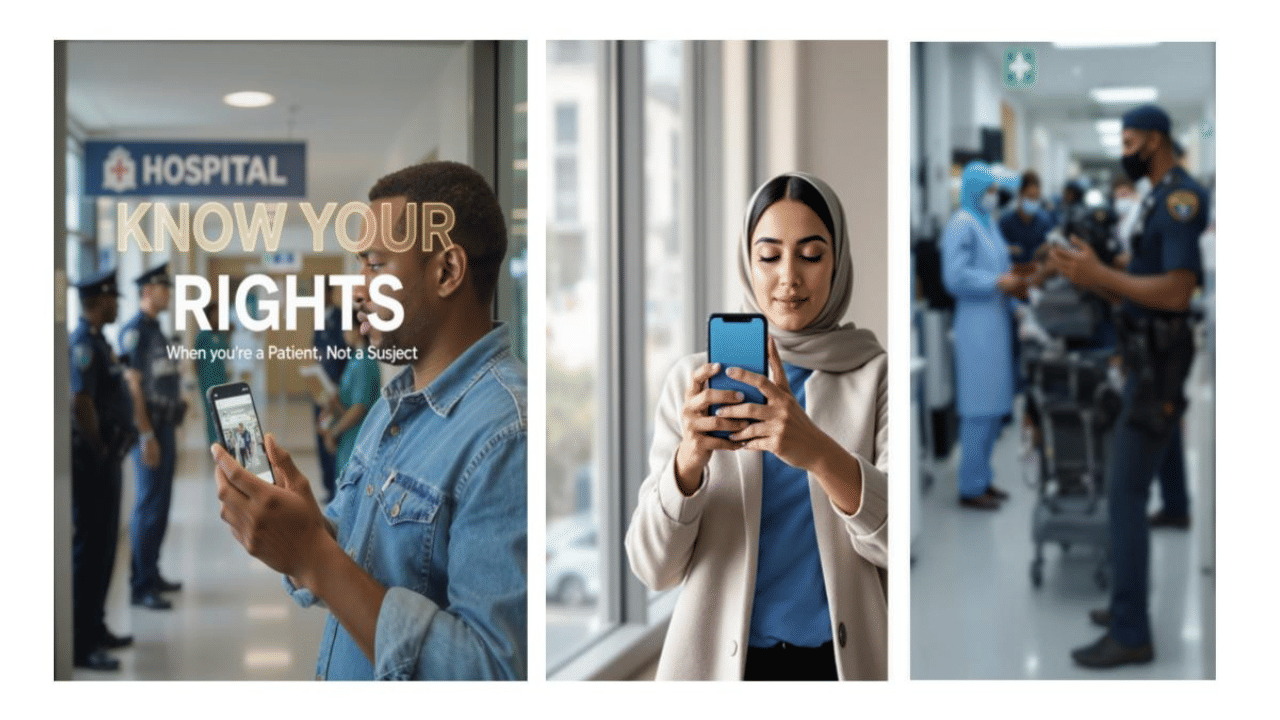
By Lustitia Aequalis
Hospitals are meant to heal. They are places where vulnerability meets expertise— where people go to be cared for, not criminalized. But in the United States and globally, healthcare settings are increasingly becoming entangled with law enforcement, raising serious concerns about patient rights, racial disparities, and medical ethics.
So, can a hospital call the police on you? The answer: Yes, but under limited and specific conditions. Understanding when it’s appropriate, and when it’s not, is critical to protecting your rights, especially if you're part of a community disproportionately impacted by over-policing.
Hospitals can contact law enforcement in certain circumstances, including:
If a patient is violent or poses a threat to others or themselves
If a patient is in possession of illegal substances or weapons
If staff believe a crime occurred on hospital grounds
In compliance with mandatory reporting laws (e.g., gunshot wounds, child or elder abuse)
However, routine care should not involve police. A patient’s presence in an emergency room does not mean they surrender their constitutional rights.
🔐 HIPAA & Medical Privacy: What’s Protected?
Under the Health Insurance Portability and Accountability Act (HIPAA), your medical information is protected. Hospitals cannot share your health data with police unless:
You give explicit consent
Law enforcement presents a court order, subpoena, or warrant
There’s an imminent threat to health or public safety
(Source: U.S. Dept. of Health & Human Services - HIPAA Guide)
Even when police are present, you have a right to confidentiality. Always ask hospital staff what information is being shared— and why.
👮♀️ What to Say If Police Approach You During Medical Care
If you’re approached by law enforcement while seeking or receiving care, remain calm and assert your rights:
You are not required to answer questions without legal representation present.
Politely say: “I am receiving medical care and would like to continue in peace.”
If unclear, ask directly: “Am I being detained or am I free to go?”
Unless you are under arrest or a specific threat is identified, you should not be removed from medical care or interrogated in your most vulnerable state.
⚖️ Criminalizing the Vulnerable: Who’s Most at Risk?
Research shows Black, Indigenous, and people of color (BIPOC) are more likely to be criminalized in healthcare settings, especially during mental health crises or substance use-related visits.
A 2021 study by the Journal of the American Medical Association (JAMA) found racial disparities in emergency room outcomes— Black patients were more likely to be restrained, sedated, or reported to security.
(Source: JAMA Psychiatry, 2021)
🌐 What About Outside the U.S.?
Globally, protections vary:
Canada: Patient privacy is protected under the Personal Health Information Protection Act. Police require a court order unless there's a risk of harm.
Germany: Strong medical confidentiality laws under the Federal Data Protection Act prohibit unauthorized disclosures.
South Africa: Law allows reporting for criminal offenses, but police may not interfere with care unless a threat exists.
United Kingdom: The NHS has strict rules on data sharing; police must show cause and cannot bypass care.
In most democracies, interference with patient care is a last resort, not standard practice.
📲 How the Witness App Can Help You Stay Protected
In critical moments, especially while traveling, receiving care alone, or navigating emergencies, the Witness app by Lustitia Aequalis is your silent advocate.
Key features include:
📁 Emergency upload of key medical documents (e.g., allergies, medications, conditions)
📍 Real-time location sharing with loved ones during crises or detainment
🎥 Automatic video and audio recording if you’re approached by police in a hospital or ambulance
🚨 Your Rights Are Non-Negotiable
Being a patient does not make you a suspect. Being in crisis does not erase your dignity. Whether you’re seeking emergency care, managing a chronic illness, or advocating for a loved one, you have the right to medical care without criminalization.
🛡️ Quick Checklist: Protecting Yourself in Healthcare Settings
✅ Ask: “Am I being detained?”
✅ Say: “I do not consent to questioning without legal counsel.”
✅ Download Witness and upload vital documents
✅ Alert your emergency contact when entering care alone
✅ Share this article with #JusticeInCare
Know when you're a patient, not a suspect. And if anyone forgets? Be ready—with your rights, your voice, and your Witness app.
📚 Sources:
HIPAA Privacy Rule - HHS.gov
JAMA Psychiatry: Racial Disparities in Emergency Room Care
National Nurses United - Policing in Hospitals
U.K. NHS Privacy Law - gov.uk
Canadian Medical Privacy: PHIPA Overview
Witness App by Lustitia Aequalis - Learn More
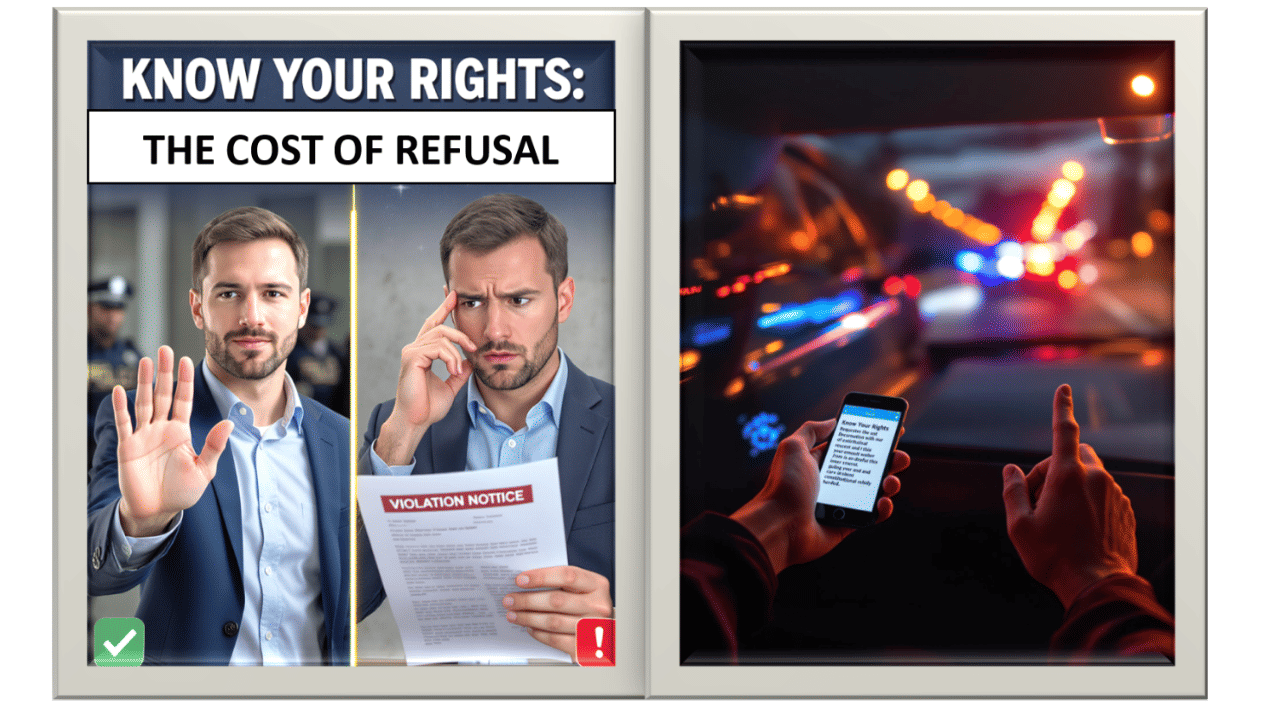
By Lustitia Aequalis
Because Knowing Your Rights Is Only the First Step— Knowing the Risks Is the Next
Can you legally refuse a police search?
Yes.
Should you? That depends— and it could cost you.
Constitutional rights apply equally to all. In practice, the consequences of asserting those rights can vary dramatically depending on where you are, who you are, and who is watching. In overpoliced communities and poor neighborhoods, refusing a search can escalate a situation even if the law is on your side.
🚨 In the United States
The Fourth Amendment of the U.S. Constitution protects against unreasonable searches and seizures. This means law enforcement generally needs either:
A warrant
Probable cause
Or your voluntary consent
If none of those are present, you have the right to say no. Courts have ruled that this refusal does not count as suspicious behavior.
🔑 Always say clearly and calmly:
“I do not consent to this search.”
That phrase is critical if you end up in court. Without it, a judge may interpret silence or passive compliance as consent.
⚠️ But Here’s Where It Gets Complicated
Saying no doesn’t always stop a search. And how you say it can matter almost as much as what you say. If police believe they have probable cause or exigent circumstances, they might proceed anyway, right or wrong.
In those moments:
Don’t argue. Don’t resist.
Document if you can.
Use apps like Witness to record the interaction, save your location, and alert an emergency contact.
Refusing a search might not stop the violation, but it might win your case later.
🧑🏽⚖️ What Happens If You Refuse?
Refusing a search can:
Trigger verbal or physical escalation by police (especially in the absence of human witnesses or body cameras)
Be documented in reports or court proceedings, even if it’s legally protected
Lead to intimidation, retaliation, or arrest on unrelated charges
Save you from wrongful prosecution if the search was unlawful
The cost of noncompliance is not uniform. According to a 2021 study by the Vera Institute, Black Americans are more likely to experience force or intimidation in routine encounters, including stops involving a search.¹
🌍 Global Comparisons: Do You Have the Same Rights Elsewhere?
Canada: Police can’t search you without a warrant, consent, or reasonable grounds. You're not legally obligated to comply without one.²
UK: Officers may search you in public places without a warrant under "stop and search" laws—but must explain the reason and provide their ID. You may decline if they do not follow proper procedure.³
Australia: Police can only search without a warrant under specific legislation like the Law Enforcement (Powers and Responsibilities) Act. If not covered, refusal is legal.⁴
South Africa: The Constitution guarantees protection against arbitrary searches. You can refuse unless there is clear suspicion of a crime.⁵
Even in democracies, how these rights are enforced, and the real-world risks of refusal, depend on race, class, gender, and geography.
How the Witness App Protects You
Lustitia Aequalis’ Witness app was designed for these exact moments.
When you're unsure what will happen next, Witness makes sure someone knows what's happening now.
Video & audio recording with one tap
Secure cloud upload so footage can't be deleted until you say so
Automatic text alert to emergency contacts
Refusal is your right, and preparation is your protection.
✅ What to Do If You’re Asked to Consent to a Search
Stay calm.
Ask, “Am I free to go?” If yes, walk away. If not, say:
“I do not consent to this search.”
Don’t resist physically— even if they proceed.
Activate Witness or begin recording visibly if it’s safe.
Document everything afterward (badge number, location, time).
📣 Your Rights Are Yours, But That Doesn’t Mean They’re Free
In a just society, saying “no” would be the end of it. However, today we must calculate the cost of compliance and the price of resistance, especially in under-protected, over-policed communities.
Let your camera be your witness. Let the law be your defense. And let your preparation be your protection.
Because justice needs evidence. And so do you.
🔗 Sources:
Vera Institute of Justice, Policing and Racial Injustice (2021): https://www.vera.org
Government of Canada, Your Rights Under Arrest: https://www.justice.gc.ca
UK Home Office, Stop and Search Powers: https://www.gov.uk/police-powers-to-stop-and-search
NSW Police, Search and Seizure: https://www.police.nsw.gov.au
South African Constitution, Section 14 - Privacy: https://www.justice.gov.za/legislation/constitution
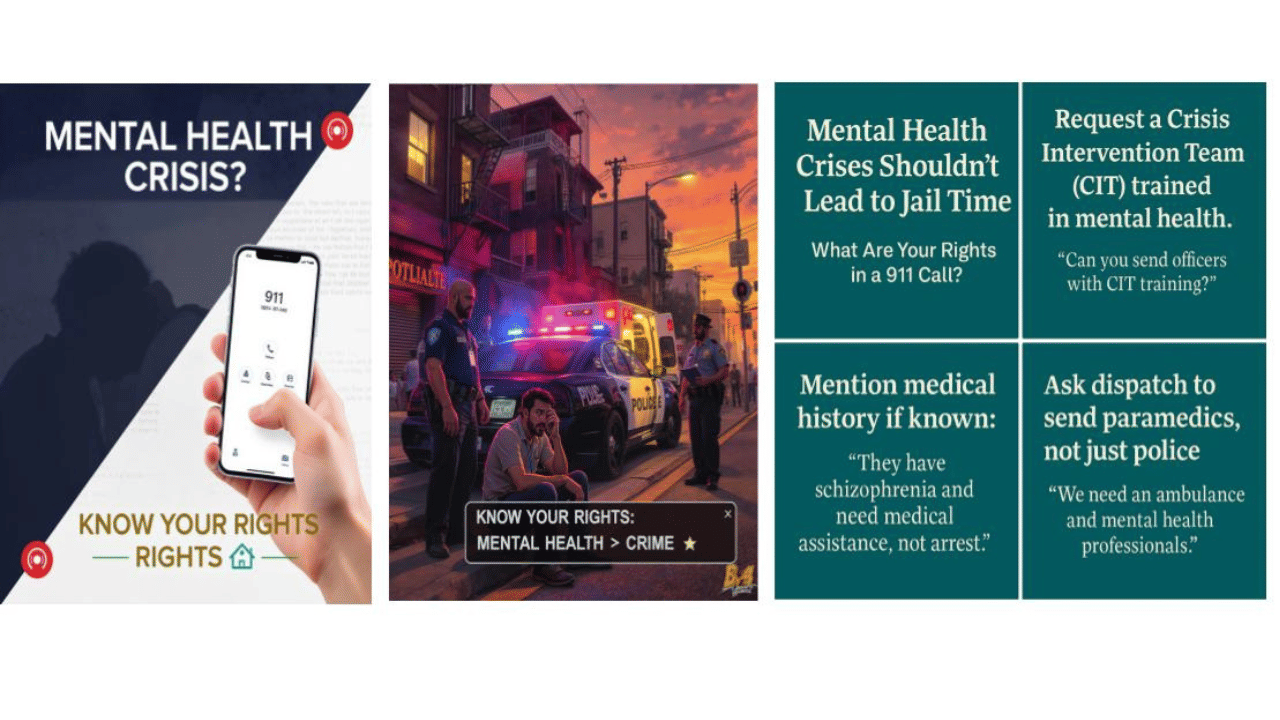
By Lustitia Aequalis
When someone is experiencing a mental health crisis, a call for help should lead to care, not handcuffs. Yet, in cities and towns across the United States and globally, law enforcement remains the first and often only response. This practice disproportionately harms marginalized communities, and the consequences can be fatal.
What Should Happen When You Call 911?
When you dial 911 for a mental health emergency, you have rights, and you can make specific requests to increase the chances that you or your loved one is treated as a patient, not a criminal.
Here’s how you can advocate effectively:
Request a Crisis Intervention Team (CIT): Many cities have trained officers who specialize in de-escalating mental health crises. Ask dispatch:
“Can you send officers with CIT training?”Mention medical conditions: Clearly state if the person has a known diagnosis.
“They have schizophrenia and need medical assistance, not arrest.”Ask for paramedics or mental health responders:
“We need an ambulance and mental health professionals, not just police.”Share if there are weapons involved or not. This can change how responders approach the scene. Say clearly:
“There are no weapons. This is a mental health emergency.”Use alternatives like 988 if you’re in the U.S. and don’t need an immediate police response. The 988 Suicide & Crisis Lifeline offers support without automatically involving law enforcement.
The Case of Sonya Massey: A Call for Compassion, Not Criminalization
In July 2023, Sonya Massey, a 36-year-old Black woman in Springfield, Illinois, called 911 during a mental health crisis. She needed help. But the officers who arrived reportedly mocked and escalated the situation. Within minutes, Massey was shot and killed by police in her own home. Her story is not isolated. It is part of a systemic issue where mental illness is criminalized rather than treated.
Her death ignited protests and demands for police accountability and reforms in mental health crisis response. In 2024, Illinois lawmakers began revisiting statewide training standards and the role of non-police crisis teams in emergency response, but change remains slow and uneven.
Global Context
The issue isn’t confined to the U.S. International responses vary widely in their approach:
United Kingdom: The UK uses Mental Health Liaison Officers and NHS Crisis Teams in many areas. However, racial disparities remain a concern. Black people in the UK are over four times more likely to be detained under the Mental Health Act (NHS, 2022).
Canada: Several provinces are piloting non-police mental health crisis teams, but police remain heavily involved in most 911 calls involving mental illness.
Australia: Some states use community-based mobile mental health crisis units, but rural areas often lack non-police options.
How the Witness App Can Help
The Witness App by Lustitia Aequalis is designed to support individuals during high-stakes encounters with law enforcement or healthcare systems. In a mental health crisis:
Record incidents discreetly
Log medical information securely
Alert trusted contacts via text
Save and send real-time updates about the encounter
This technology empowers families and individuals to document the truth in situations that often lack transparency.
Know Your Rights. Protect Your People.
If you or a loved one is in crisis, your goal is safety, not a confrontation. Calmly advocate for medical intervention. Avoid escalating language, and make sure responders know this is a health issue, not a criminal act.
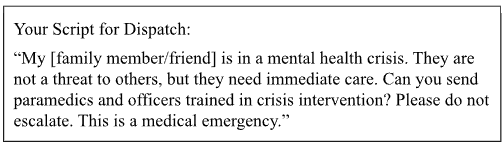
Final Thought
Mental illness is not a crime. A mental health episode should never end in jail, or worse. With knowledge, technology, and advocacy, we can push for systems that prioritize care over punishment.
Resources:
988 Suicide & Crisis Lifeline
Treatment Advocacy Center – CIT Guide
ACLU – Mental Health and Policing
By Lustitia Aequalis
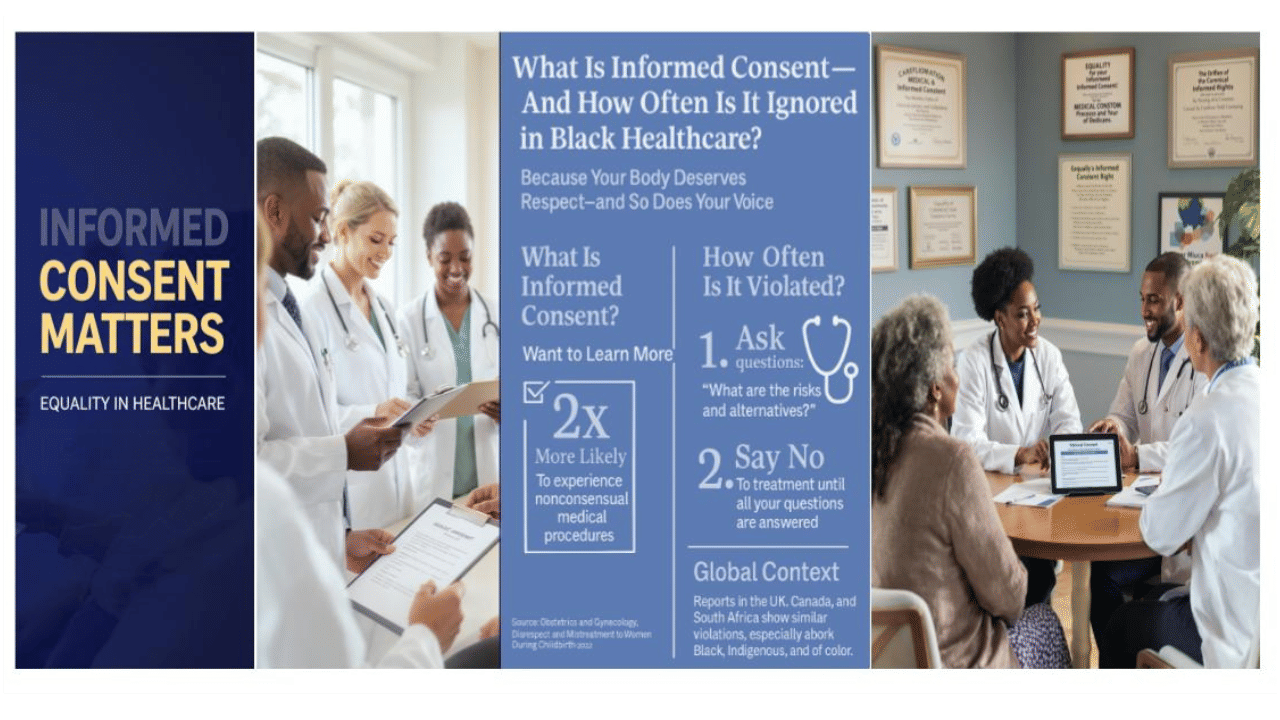
🩺 What Is Informed Consent?
Informed consent is the legal and ethical requirement that a medical provider must explain your diagnosis, treatment options, risks, benefits, and alternatives— and receive your clear, voluntary agreement before performing any procedure or giving any treatment.
You have the right to:
✅ Ask, “What are the risks and alternatives?”
✅ Say no until all your questions are answered
✅ Pause or refuse treatment without retaliation
✅ Document conversations or upload consent forms using the Witness App
It is your body. It is your choice. And your consent is not optional, it’s fundamental.
📉 The Reality: How Often Is It Ignored?
For many people, especially Black patients, informed consent is not a guaranteed experience. It is too often rushed, assumed, or entirely bypassed.
A 2022 study published in Obstetrics & Gynecology found that Black women were more than twice as likely as white women to experience non-consensual procedures during childbirth.¹
Other studies confirm:
Black patients are less likely to receive clear explanations about treatments²
Providers are more likely to dismiss pain or concerns raised by Black patients³
Coercion, intimidation, and “sign here” forms are common in emergency rooms and psychiatric settings⁴
This is not just a violation of ethics, it is a continuation of medical racism rooted in a legacy of experimentation, neglect, and structural bias.
🌍 A Global Pattern of Disrespect
This isn’t just an American problem, it’s a global one:
UK: Black and South Asian patients are disproportionately subjected to coercive care and a lack of autonomy in the National Health Service.⁵
Canada: Indigenous women have reported being sterilized without consent and receiving inadequate consent explanations for high-risk procedures.⁶
South Africa: A Human Rights Watch report revealed widespread non-consensual procedures, particularly in rural and marginalized communities.⁷
The common thread? When healthcare systems view Black, Indigenous, and people of color as less entitled to dignity, consent becomes optional and harm becomes normalized.
💡 What You Can Do
📌 Ask Clearly:
“What are the risks, benefits, and alternatives?” If they rush or dismiss
your question, slow them down.
📌 Say No:
“I need more time before I agree.” Consent under pressure is not informed consent.
📌 Use the Witness App:
Upload consent forms and medical instructions
Record conversations in states where it’s legal
Alert someone you trust during medical encounters
Document how you were treated, especially if you suspect a violation of your rights or hospital policies
Informed consent is your right—not a privilege.
And when your consent is ignored, your story—and your evidence—can help stop the cycle.
Let’s reclaim our voice.
Let’s defend our dignity.
Let’s make medical justice real.
🧾 Sources:
Obstetrics & Gynecology, 2022. “Disrespect and Mistreatment to Women During Childbirth”
Institute of Medicine. Unequal Treatment: Racial and Ethnic Disparities in Health Care, 2003
Journal of Pain Research, 2019. “Disparities in Pain Management”
National Partnership for Women & Families, 2021. Birth Equity Brief
UK Care Quality Commission, 2022. Maternity and Mental Health Services Report
CBC News, 2020. Forced Sterilizations in Saskatchewan
Human Rights Watch, 2020. Non-Consensual Medical Procedures in South Africa

By Lustitia Aequalis
We hear it too often: “If they just followed orders...” or “They shouldn’t have broken the law.”
But what if there was no crime? What if the “suspicious behavior” was jogging, playing in a park, or sleeping at home?
The idea that police violence is always justified rests on a dangerous myth: that the moment someone disobeys—even slightly —they forfeit their rights. But this is not how democracy works. In the United States, we do not grant law enforcement the power to be judge, jury, and executioner.
And yet, many people have been killed while doing things that millions of people do every day.
🚨 The Myth of “Justified Force”
Some still believe that if someone might be doing something illegal, the police have a right to use brutal or deadly force. But that belief erodes the foundation of our legal system: the right to due process.
Due process is guaranteed under the U.S. Constitution’s Fifth and Fourteenth Amendments. It means that everyone is entitled to fair treatment through the legal system, not summary judgment at the hands of armed officers.
📋 The Ordinary Acts That Ended in Gunfire
The following people weren’t caught in a high-speed chase or pointing weapons. They were engaged in normal activities when they were killed:
🏡 Breonna Taylor
What she was doing: Sleeping in her bed.
Police conducted a botched no-knock raid on her Louisville, KY apartment in March 2020. She was shot multiple times.
(Source: NY Times, 2020)
🏃🏽 Stephon Clark
What he was doing: Standing in his grandmother’s backyard.
Sacramento police shot him 20 times, claiming he had a weapon. It was a cellphone.
(Source: CNN, 2018)
🚗 Philando Castile
What he was doing: Informing police he had a licensed firearm during a traffic stop.
He was shot five times in front of his girlfriend and her child while reaching for his wallet.
(Source: Washington Post, 2016)
👦🏽 Tamir Rice
What he was doing: Playing with a toy gun in a Cleveland park.
Police arrived and shot the 12-year-old within two seconds of exiting the vehicle.
(Source: The Guardian, 2015)
🚶🏿 Elijah McClain
What he was doing: Walking home from a convenience store.
A 911 caller described him as “sketchy” because he wore a ski mask (he was anemic).
He was placed in a chokehold by police, injected with ketamine by paramedics, and died days later.
(Source: CNN, 2020)
💤 Atatiana Jefferson
What she was doing: Playing video games with her 8-year-old nephew at home.
A neighbor called a non-emergency line for a wellness check. Police arrived and shot her through a window.
(Source: NPR, 2019)
👩🏽⚖️ The Right to Due Process Doesn’t Expire on the Street
Police are not empowered to act as judge, jury, or executioner. However, public narratives often excuse their actions by suggesting that the person might have broken the law or resisted orders. This mindset is a slippery slope that undermines the entire justice system.
Even those who break the law still have civil and human rights. Here's what the law actually says:
Graham v. Connor (1989): Use of force must be “objectively reasonable,” considering the totality of the circumstances, not just suspicion or defiance.
Tennessee v. Garner (1985): Police may not use deadly force against fleeing suspects unless they pose a clear and present danger.
Even under these laws, courts have often sided with police, but that doesn’t make the killings just. The law’s failure to deliver accountability is not proof of innocence; it’s a signal of systemic failure.
🧠 What You Can Do
📲 Document the interaction: Use apps like the Witness App to record safely and securely.
🧾 Know your rights: No one is required to speak, consent to a search, or obey illegal orders.
📢 Change the narrative: When someone says, “They shouldn’t have resisted,” ask:
“Should resisting mean death?” In a just society, the answer is no.
🛡️ Final Thought
These weren’t high-stakes battles. They were everyday moments, sleeping, walking, driving, playing, that ended in death at the hands of those sworn to protect.
If we allow minor suspicion or noncompliance to justify execution, then we’ve replaced due process with street justice.
The Constitution doesn’t disappear when the police show up. And justice doesn’t live in a holster.
📚 Sources:
CNN: Black Lives Matter: What People Were Doing When Police Shot Them, 2020
The New York Times, Breonna Taylor Timeline, 2020
NPR: Atatiana Jefferson Was Killed During a Wellness Check, 2019
The Guardian: Tamir Rice Case Timeline, 2015
Washington Post: Philando Castile Shooting, 2016
U.S. Supreme Court: Graham v. Connor, 1989; Tennessee v. Garner, 1985
No matter who you are, knowing your rights should never feel like a privilege. It’s your protection. But too often, marginalized communities face legal systems that are complicated, biased, and dangerous to navigate alone. That’s why we created the Witness App, publish powerful guidance, and amplify stories that demand accountability.
✊🏾 Join us in transforming bystanders into advocates, patients into protectors, and communities into forces for justice.Because justice needs evidence and so do you.
🗳️ COMMUNITY POLL: How Confident Are You in Knowing Your Rights?
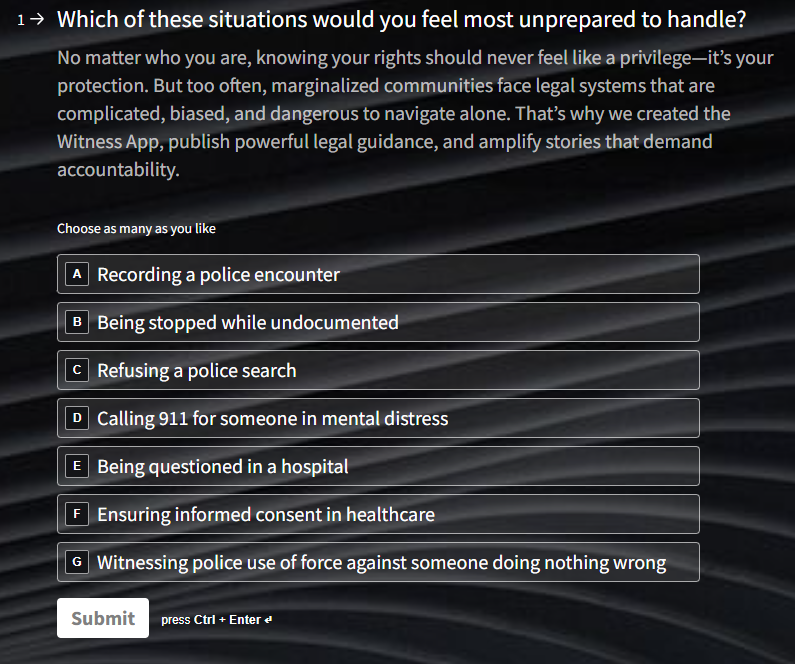
🟨 Vote now and share your experience. Your insight helps shape the resources and tools we build.